Hello, everyone. My name is Daichi, an expert providing the information about the radiation issues in an easy-to-understand manner.
In this article, the approach for the decontamination outside Fukushima Prefecture and for the storage of removed soil were elaborated.
Toward the future the stored soil need to be disposed, and in this article pilot projects will be explained that have been implemented to collect knowledge to establish the standard for the disposal.
So this article responds to the following question.
– What kind of pilot projects have been implemented to determine the standard for disposal of removed soil?
Table of contents of this article
- (Pilot projects are elaborated) Disposal of removed soil generated outside Fukushima Prefecture (Vol. 2)
- Pilot projects for disposal of removed soil outside Fukushima Prefecture
- Project for test burying of removed soil
- Pilot project for disposal of removed soil in Ibaraki, Tochigi and Miyagi Prefectures
- Summary
I have been involved with the radiation-relevant issues, like the policy on the decontamination activities and the management of the Interim Storage Facility, after the accident of the Fukushima Daiichi Nuclear Power Plant in 2011.
I received a doctorate in the field of radiation, while working in Fukushima.
(Pilot projects are elaborated) Disposal of removed soil outside Fukushima Prefecture (Vol. 2)
So let’s start explanation on pilot projects on disposal of removed soil outside Fukushima Prefecture that made an important role to determine the standard for the disposal of removed soil.
Pilot projects for disposal of removed soil generated outside Fukushima Prefecture
Regarding the pilot projects for disposal of removed soil, there are two projects: ‘Project for test burying of removed soil’ conducted relatively early after the start of decontamination activities, and ‘Pilot project for disposal of removed soil’ conducted in Ibaraki, Tochigi and Miyagi Prefectures.
I will give an explanation on each project one by one.
Project for test burying of removed soil
The issue that how the removed soil outside Fukushima Prefecture has been considered since shortly after the accident, and the oldest material that I can identify here is the material No.4 of the 11th Review Meeting on Environmental Restoration (March 2014): the dynamics of radioactive cesium pertain to burying of removed soil (in Japanese).
Although the specific time and location have not been disclosed, but this project was implemented in three parks in the ICSA in the Kanto Region.
It seemed to start before two years had passed since the accident, because we can see data on February 2023.
Specifically, following tests and simulations were conducted, to analyze the dynamics of radioactive cesium in soil.
– Core boring test to monitor the concentration of radioactive cesium in soil in vertical direction and monitoring of radioactive cesium concentration in infiltration water in bottom layer of test sites (field test)
– Laboratory test under ideal and extreme conditions using soil obtained in test sites
– Numerical simulation of long-term migration over field and laboratory testing periods
| Test items | Check items | Terms | |
|---|---|---|---|
| Field test | - Soil analysis (depth distribution) - Analysis of infiltration soil water | Radioactive cesium migration in soil under actual environment - Downward migration (rainfall infiltration) - Upward migration (capillary rise) | ~10 months |
| Laboratory test | - Water flow column test - Elution characteristics test - Adsorption characteristics test | - Radioactive cesium migration in soil (e.g., suspended soil particles; ideal to severe conditions) - Solubility (long-term, effects of coexisting cations) - Sorption distribution coefficient (degree of sorption to soil) | ~10 months |
| Numerical analysis | - One-dimensional advection-dispersion model (simulation) | Long-term migration prediction beyond the timescales of field and laboratory tests (models using sorption distribution coefficients) | ~100 years |
I won’t go into details here, but the results are as follows:
1. As a result of the field test and the water flow column test, the migration of radioactive cesium in the soil was not confirmed in either the soil or soil water analysis (below the detection limit).
2. As a result of the elution characteristics test using soil from the field test site, no leaching of radioactive cesium into pure water and 1 mol/L ammonium acetate solution was confirmed (below the detection limit).
3. As a result of the adsorption characteristic test using soil from the field test site, the sorption distribution coefficient was on the order of 103 mL/g, even including the upper limit of the ammonium ion concentration expected in the actual environment.
4. As a result of numerical analysis as a long-term prediction, it was confirmed that within the range of the range of normally assumed sorption distribution coefficients, the movement of radioactive cesium is slow, its migration range is limited to a narrow area around the removed soil (approximately several tens of centimeters over 100 years), and it decays according to its half-life.
Regarding 2, the possibility that naturally occurring ammonium ions compete strongly with the adsorption sites for radioactive cesium in the soil and cause the cesium to be desorbed was tested.
Although a concentration of ammonium ions much higher than that actually found in nature (100 to 10,000 times higher) was used, the conclusion was that no leaching was observed.
Regarding 3, it represents the strength of retention power of soil to capture radioactive cesium.
The sorption distribution coefficient describes here the degree how strong soil retains radioactive cesium, and the larger the value is, the more firmly the soil retain the radioactive cesium.
If the sorption distribution coefficient is around 10-100, it means that radioactive cesium is easily detach, but if it is of the order of 103, it means that radioactive cesium is firmly fixed to the soil particle.
As a result of the above-mentioned tests, I think that it had been reveled that radioactive soil is firmly adsorbed to the soil particle and exists in a state that it doesn’t easily migrate in the environment.
Pilot project for disposal of removed soil in Ibaraki, Tochigi and Miyagi Prefectures
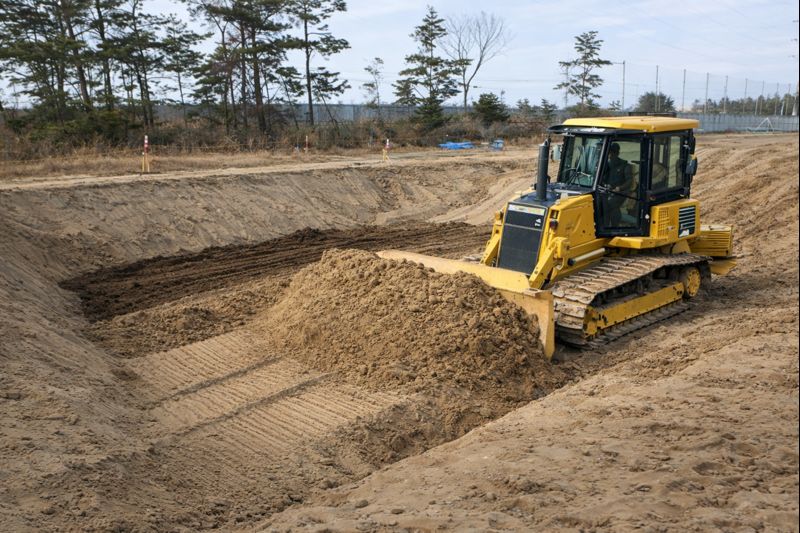
Afterwards, in around 2 years and 9 months, in the 17th Review Meeting on Environmental Restoration (December 2016), the establishment of ‘the Review Team on Disposal of Removed Soil‘ (in Japanese) was endorsed and the consideration of the standard for disposal of removed soil outside Fukushima Prefecture had been accelerated.
In September 2017, the 1st Review Team on Disposal of Removed Soil (in Japanese) was held and in the 2nd Review Team on Disposal of Removed Soil (in Japanese) in December 2017, objective and specific contents of pilot project for the disposal of removed soil were discussed.
In the 3rd Review Team on Disposal of Removed Soil (in Japanese) onward in September 2018, the contents and progress of the demonstration projects: the project in Tokai Village in Ibaraki Prefecture (August 2018 – March 2025) and the project in Nasu Town in Tochigi Prefecture (September 2018 – September 2019 (restored in March 2020)) were reported and discussed.
In May 2019, the Results of the Demonstration Project on Landfill Disposal of Removed Soil (Interim Report) (in Japanese) was published.
After that, in Marumori Town in Miyagi Prefecture, the pilot project (started in December 2021 and restored in April 2024) was launched to confirm that removed soil can be safely separated from removed waste, followed by landfill disposal, and in the 7th Review Team on Disposal of Removed Soil (in Japanese) in March 2022 and after, the progress of the project had been reported.
Removed wastes (e.g. grass, branches) are basically collected and stored separately from removed soil, but it is difficult to separate completely, and it is inevitable that removed soil is mixed with removed waste during remediation to some extent.
If it can be regarded as waste as a whole, and if it is not the Designated Waste, it can be treated as the Specific Municipal Waste in each municipality, but I think that there are cases when it can’t be treated in an incineration plant due to the disagreement between local people and municipalities, or when too much soil is included.
With this in mind, these were the pilot projects in which removed soil is separated from removed waste to reduce the volume of removed waste to be disposed of, and to homogenize its quality, in order to improve the feasibility of treatment of removed waste.
The difference of the pilot projects are summarized in the following table.
| Tokai Village, Ibaraki Pref. | Same as left | Same as left | Same as left | Nasu Town, Tochigi Pref. | Marumori Town, Miyagi Pref. | Same as left | |
|---|---|---|---|---|---|---|---|
| Ditrict 1 | Same as left | Ditrict 2 | Ditrict 3 | ||||
| Section 1 | Section 2 | Pit 1 | Pit 2 | ||||
| Treated stuff | Removed soil | Removed soil | Removed soil | Soil separated from removed waste | Removed soil | Soil separated from removed waste | Removed soil and soil separated from removed waste |
| Location of the pilot project | Within the grounds of the Nuclear Science Research Institute of the Japan Atomic Energy Agency | Same as left | Same as left | Same as left | Iono Yamamura Square | Kamitaki Temporary Storage Site | Same as left |
| The amount of landfill (actual value) | 351 m3 | 290 m3 | 787 m3 | (Planning) | 217 m3 | 88.7 m3 | 88.6 m3 |
| Storage location | Toyooka Nagisa Forest | Masaki Kofun Park | Toyooka Nagisa Forest and three other locations | Same as left | Iono Yamamura Square | Kamitaki Temporary Storage Site | Kamitaki Temporary Storage Site |
| Landfill thickness (actual value) | 1.2 m | 1.2 m | 3.7 m | (Planning) | 1.2 m | 1.2 m | 1.2 m |
| Thickness of cover soil (actual value) | 0.3 m | 0.3 m | 0.3 m | (Planning) | 0.3 m | 0.5 m | 0.5 m |
| Method for water collection | Water collection pit | Same as left | Same as left | (Planning) | Impermeable sheet + water collection pit | Impermeable sheet + water collection pit | Same as left |
| Sorting of removed waste | - | - | - | 2021: Preliminary survey 2022: Sorting | - | 2021-2022: Preliminary survey | Same as left |
(Source) Reference Material 4, the 11th Review Team on Disposal of Removed Soil
I will not go into detail, but regarding the pilot projects, in the 11th Review Team on Disposal of Removed Soil (in Japanese), it comes to the following conclusions.
– It was confirmed that the radiation exposure dose associated with landfill work for removed soil and waste was less than 1 mSv per year.
– Throughout the landfill operations and the post-landfill management period, no impacts on the surrounding environment were observed in any of the pilot projects, caused by dispersion or runoff of removed soil and waste, or infiltration of radioactive materials into the ground.
More specific conclusions are as follows:
– During landfill
- The air dose rate (at the site boundary) remained almost within the range of fluctuation between the preparation stage and the pre-landfilling stage.
- The radioactivity concentration in the air (at the site boundary) was sufficiently low: a maximum of 0.18 mBq/m3 in Tokai Village, below the detection limit in Nasu Town, and a maximum of 0.18 mBq/m3 in Marumori Town (during the separation work).
– After landfill
- The air dose rate at the site boundary and the radioactivity concentration in the air remained within the range of fluctuations observed before the landfilling work.
- The radioactivity concentration in leachate water is below the detection limit for all samples. No impacts were observed from Typhoon No.19 in 2019 (Daily precipitation: 93 mm in Tokai Village, 275 mm in Nasu Town).
- In Marumori Town, landfilling of “soil and humus,” separated from removed waste, was conducted; however, no significant difference was observed when compared with landfilling of removed soil only.
Based on these results, it was concluded that no adverse impacts were observed with respect to worker doses or the surrounding environment, including air dose rates and radioactivity concentrations in the air and leachate water.
Please visit this website (in Japanese) for the results of the pilot projects.
Summary
Regarding the disposal of removed soil outside Fukushima Prefecture, this article covered two pilot projects.
As a result of these pilot projects, it is evaluated that:
– Radioactive cesium is strongly adsorbed onto soil particles and is therefore not readily mobile in the environment.
– Under the conditions of the pilot projects, no adverse impacts were observed on worker doses or the surrounding environment; therefore, the removed soil can be safely disposed of.
By the way, above-mentioned contents are summarized in the following videos.
– Japanese version
(Published at a later date)
– English version
(Published at a later date)
You can read the same article in Japanese here.
Thank you very much for reading this article.
See you next time!


コメント